
February 25, 2026
In aerospace manufacturing, the ability to create complex, high-performance structures often determines what’s possible in aircraft design. As engineers push the boundaries of performance, efficiency, and weight reduction, advanced hot forming of aerospace structures has emerged as a critical capability for shaping titanium and other challenging materials into the intricate geometries that modern platforms demand.
The team at Re:Build Cutting Dynamics is committed to providing hot forming solutions: Contact our team today to discuss your aerospace manufacturing needs.
Modern aircraft require components that can withstand extreme conditions while maintaining minimal weight. Engine components must endure temperatures exceeding 1,000°F. Structural elements need to handle enormous stresses during takeoff, flight, and landing. Firewall assemblies must provide reliable protection in the harshest environments.
These requirements create a manufacturing paradox: the materials strong enough to meet performance demands are often the most difficult to form. Titanium, valued for its exceptional strength-to-weight ratio and resistance to extreme temperatures, is notoriously challenging to shape into the complex contours that aerospace designers envision.
While basic titanium shapes can be formed at room temperature, complex geometries with tight tolerances require the hot forming process. The reason lies in titanium’s material properties. As temperature increases, the material’s yield curve lowers to a point where it can stretch and form without cracking or becoming brittle.
This transformation is crucial for aerospace applications. Two-thirds of the world’s titanium alloy is used exclusively in aircraft, supporting advanced aviation applications including jet engines, firewalls, missiles, engine and exhaust components, landing gear, and key superstructure joints.
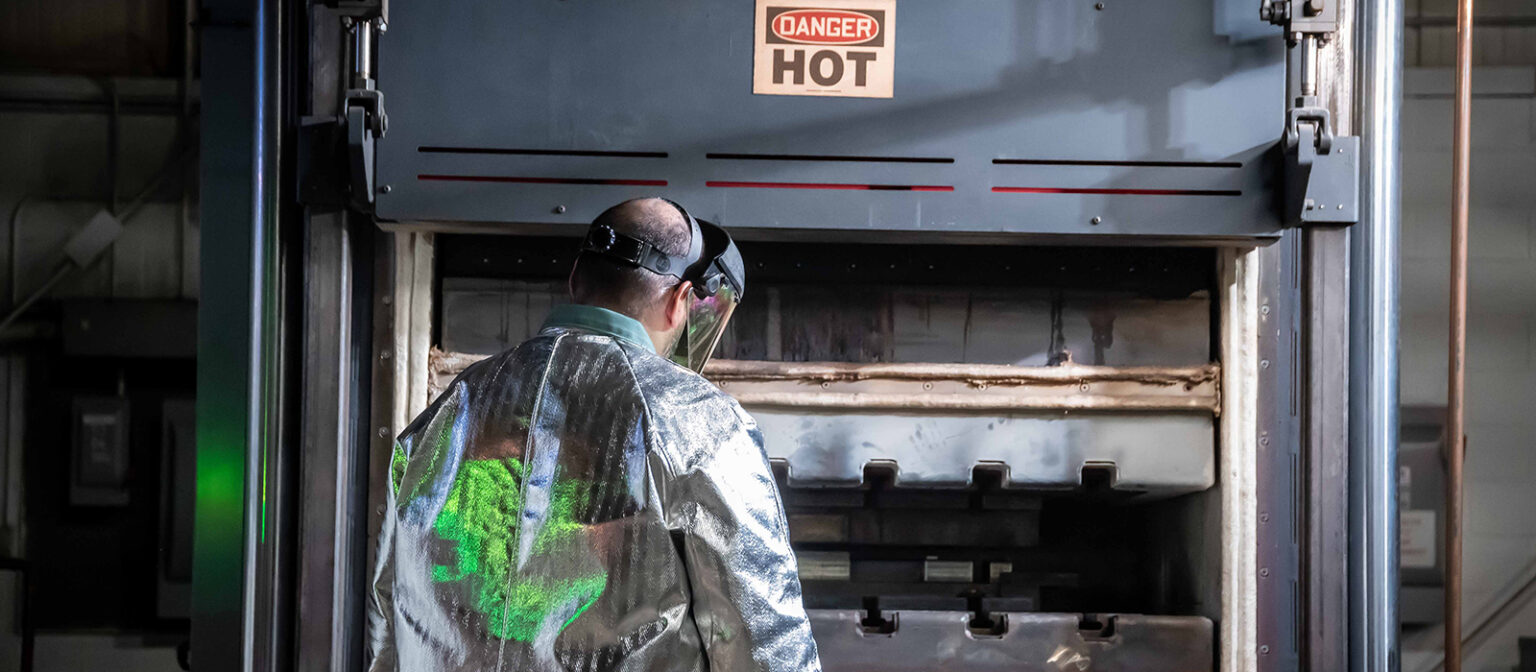
The hot forming process combines precise temperature control with specialized tooling to achieve remarkable results. At Re:Build Cutting Dynamics, we heat titanium blanks to carefully controlled temperatures, typically between 900°F and 1,350°F, making the metal pliable enough to form without compromising its structural integrity.
Once heated, the material is pressed into precision tooling that creates the desired shape. The press then holds the part under temperature and pressure for several minutes, effectively stress-relieving it in place. This critical step sets the material to the precise shape of the tooling surface and eliminates springback, the tendency of formed parts to partially return to their original shape.
Advanced hot forming requires sophisticated solutions to several technical challenges:
Hot forming delivers measurable benefits that directly impact aerospace program success:
Eliminating springback through controlled heating and holding allows manufacturers to achieve exact specifications.
The process facilitates the formation of intricate shapes with tighter radii that would be impossible or impractical with cold forming methods.
By carefully controlling temperature and pressure, hot forming minimizes the risk of cracking, ensuring product integrity for safety-critical applications.
Creating strong, lightweight structures helps reduce aircraft weight. Every pound saved translates into fuel efficiency gains and lower operating costs throughout the aircraft’s service life.
Before forming a single sheet of titanium, advanced sheet metal simulation software allows engineers to digitally model how the material will behave. This capability validates tooling and forming strategies in advance, minimizing costly tryouts, reducing waste of hard-to-source material, and accelerating time to production.
With titanium hot forming capacity increasingly scarce in the United States, having a secure domestic source is essential for program continuity and supply chain resilience. At Re:Build Cutting Dynamics, we provide more than precision-formed components. By integrating simulation, forming, fabrication, and assembly under one roof, we deliver complete solutions that shorten timelines and reduce risk.
Our 40 years of experience in aerospace manufacturing, combined with AS9100 certification and comprehensive quality systems, ensures that every component meets the rigorous standards the industry demands.
Advanced hot forming doesn’t just make titanium formable; it makes it scalable, repeatable, and efficient for the most demanding aerospace applications. As aircraft designers continue pushing performance boundaries, this capability will remain essential for creating the complex structures that define next-generation platforms.
Ready to discuss your titanium hot forming needs? Contact our team to learn how Re:Build Cutting Dynamics can support your aerospace manufacturing requirements.
Our team at Re:Build Cutting Dynamics wants to ensure that all your questions regarding hot forming have been answered. With that in mind, feel free to contact us today with any questions you may have. We look forward to assisting you.
